Why Product Analytics Doesn't Work for Customer Success (And What Does)
Amplitude, Mixpanel, and Pendo were built for product teams tracking users. Customer Success teams need to track accounts. Here's why that gap matters and what to do about it.
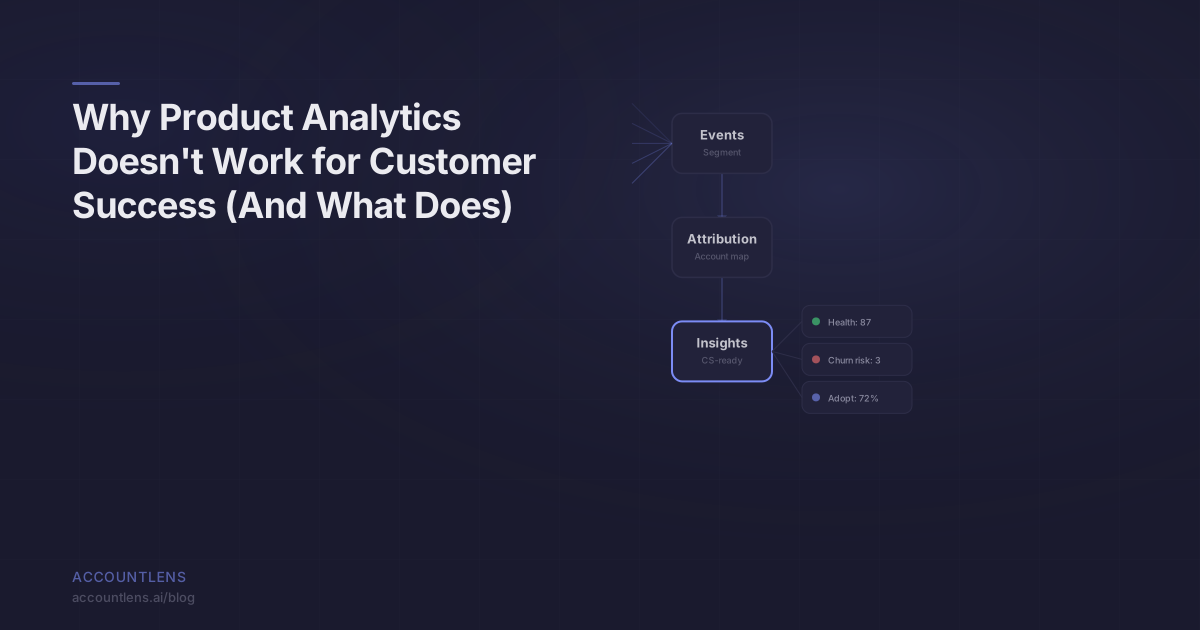
TL;DR: Traditional product analytics tools track individual users across funnels and cohorts — which is great for consumer apps with millions of anonymous visitors. But B2B Customer Success teams don’t care about users in aggregate. They care about accounts: Is Acme Corp healthy? Is their adoption growing or declining? Are they at risk before renewal? No mainstream analytics tool answers these questions natively. That’s the gap AccountLens fills.
Your CS team has a renewal coming up with a $200K account. They need to know: Is this account healthy? Are they using the features they bought? Has their engagement trended up or down over the last quarter?
They open Amplitude. They see that 47% of users completed the onboarding flow last month. Cool. Completely useless for the conversation they’re about to have.
Why does product analytics fail Customer Success teams?
Because every mainstream product analytics tool was designed around the same unit of analysis: the user.
Amplitude tracks user journeys. Mixpanel builds user cohorts. Pendo measures user engagement. PostHog watches user sessions.
None of them natively answer: “How is this account doing?”
In B2B SaaS, the user is not the customer. The account is the customer. One account might have 3 users or 300. Activity from a single power user can mask the fact that the rest of the account has gone dark. Aggregate metrics hide the signal your CS team actually needs.
What do CS teams actually need from product data?
Three things, specifically:
-
Account-level health scores — A composite view of product activity, feature adoption, and engagement trends per account, not averaged across your entire user base.
-
Feature adoption by account — Not “60% of users adopted Feature X” but “Acme Corp’s team has never touched Feature X, and that’s a problem because it’s the feature they bought.”
-
Churn signals at the account level — When an account goes quiet, not when your overall DAU dips 2%. An account dropping below its own historical baseline is a signal. A global metric moving isn’t.
What’s the alternative?
The alternative is product analytics that’s organized around accounts from the start. Not a layer bolted on top of user-level data — genuinely account-centric.
AccountLens is an open-source product analytics platform that gives B2B Customer Success teams account-level health scores, feature adoption data, and churn signals. It connects to your product data via Segment, attributes every event to the right account, and makes the data available to your CS team without SQL, without engineering tickets, and without a six-figure contract.
It’s MIT-licensed and free to self-host. Your data stays yours.
Frequently Asked Questions
Why can’t I just use Amplitude with a “company” property?
You can filter by company in Amplitude, but it doesn’t compute account-level metrics natively. Health scores, account-level funnels, and per-account adoption tracking require custom work that breaks every time your schema changes. You end up building a data pipeline to answer basic CS questions.
What about Gainsight or ChurnZero?
They’re great at relationship management and CS workflows, but they have minimal product analytics depth. They’ll tell you a health score based on support tickets and NPS — not based on what accounts are actually doing in your product.
Is AccountLens ready for production use?
AccountLens is in active development and available on GitHub under the MIT license. You can self-host it today and start routing Segment events to get account-level insights.
How does AccountLens handle account attribution?
Events flow in via Segment webhook. AccountLens attributes them to the right account using your existing group/identify calls — the same data you’re already sending. Anonymous users get resolved as they’re identified.